Wer datete Catherine II of Russia?
Alexander Petrowitsch Jermolow war mit Catherine II of Russia von ? bis ?. zusammen.
Iwan Nikolajewitsch Rimski-Korsakow war mit Catherine II of Russia von ? bis ?. zusammen. Der Altersunterschied betrug 24 Jahre, 8 Monate und 22 Tage.
Alexander Dmitriev-Mamonov war mit Catherine II of Russia von ? bis ?. zusammen. Der Altersunterschied betrug 29 Jahre, 4 Monate und 28 Tage.
Alexander Dmitrijewitsch Lanskoi war mit Catherine II of Russia von ? bis ?. zusammen. Der Altersunterschied betrug 28 Jahre, 10 Monate und 6 Tage.
Sergei Saltykov war mit Catherine II of Russia von ? bis ?. zusammen.
Pyotr Zavadovsky war mit Catherine II of Russia von ? bis ?. zusammen. Der Altersunterschied betrug 9 Jahre, 8 Monate und 19 Tage.
Semyon Zorich war mit Catherine II of Russia von ? bis ?. zusammen.
Alexander Vasilchikov war mit Catherine II of Russia von ? bis ?. zusammen.
Platon Zubov war mit Catherine II of Russia von ? bis ?. zusammen. Der Altersunterschied betrug 38 Jahre, 6 Monate und 24 Tage.
Gregory Potyomkin war mit Catherine II of Russia von ? bis ?. zusammen. Der Altersunterschied betrug 10 Jahre, 4 Monate und 22 Tage.
Grigori Grigorjewitsch Orlow war mit Catherine II of Russia von ? bis ?. zusammen. Der Altersunterschied betrug 5 Jahre, 5 Monate und 15 Tage.
Stanislaus II. August Poniatowski war mit Catherine II of Russia von ? bis ?. zusammen. Der Altersunterschied betrug 2 Jahre, 8 Monate und 15 Tage.
Catherine II of Russia

Catherine II (born Princess Sophia Augusta Frederica of Anhalt-Zerbst; 2 May 1729 – 17 November 1796), commonly known as Catherine the Great, was the reigning Empress of Russia from 1762 to 1796. She came to power after a coup d'etat against her husband, Peter III. Her long reign helped Russia thrive under a golden age during the Enlightenment. This renaissance led to the founding of many new cities, universities, and theatres, along with large-scale immigration from the rest of Europe and the recognition of Russia as one of the great powers of Europe.
After overthrowing and possibly assassinating her husband and her subsequent rule of the Russian Empire, Catherine often relied on noble favourites such as Count Grigory Orlov and Grigory Potemkin. Assisted by highly successful generals such as Alexander Suvorov and Pyotr Rumyantsev and admirals such as Samuel Greig and Fyodor Ushakov, she governed at a time when the Russian Empire was expanding rapidly by conquest and diplomacy. In the west, she installed her former lover to the throne of Poland, which was eventually partitioned. In the south, the Crimean Khanate was annexed following victories over the Bar Confederation and the Ottoman Empire in the Russo-Turkish War. With the support of Great Britain, Russia colonised the territories of New Russia along the coasts of the Black and Azov seas. In the east, Russians became the first Europeans to colonise Alaska, establishing Russian America.
Many cities and towns were founded on Catherine's orders in the newly conquered lands, most notably Yekaterinoslav, Kherson, Nikolayev, and Sevastopol. An admirer of Peter the Great, Catherine continued to modernise Russia along Western European culture. However, military conscription and the economy continued to depend on serfdom, and the increasing demands of the state and of private landowners intensified the exploitation of serf labour. This was one of the chief reasons behind rebellions, including Pugachev's Rebellion of Cossacks, nomads, peoples of the Volga, and peasants.
The Manifesto on Freedom of the Nobility, issued during the short reign of Peter III and confirmed by Catherine, freed Russian nobles from compulsory military or state service. The construction of many mansions of the nobility in the classical style endorsed by the empress changed the face of the country. She is often included in the ranks of the enlightened despots. Catherine presided over the age of the Russian Enlightenment and established the Smolny Institute of Noble Maidens, the first state-financed higher education institution for women in Europe.
Lesen Sie mehr...Alexander Petrowitsch Jermolow

Alexander Petrovich Yermolov (1754–1834) was a Russian favourite and the lover of Catherine the Great from 1785 to 1786.
Yermolov was presented to Catherine by Grigory Potemkin, tested by Anna Protasova and became Catherine's lover in 1785. He collaborated with the enemies of Potemkin and attempted to have Potemkin removed, and thereby lost his position. He went to Paris in the late 1780s and spent the rest of his life in Schloss Frohsdorf.
Lesen Sie mehr...Catherine II of Russia
Iwan Nikolajewitsch Rimski-Korsakow

Ivan Nikolajevich Rimsky-Korsakov, né Korsav (29 June 1754 – 31 July 1831 in Saint Petersburg, Russian Empire) was a Russian courtier and lover of Catherine the Great from 1778 to 1779.
Lesen Sie mehr...Catherine II of Russia
Alexander Dmitriev-Mamonov

Count Alexander Matveyevich Dmitriev-Mamonov (Russian: Александр Матвеевич Дмитриев-Мамонов; 30 September 1758 – 11 October 1803, buried in Donskoy Monastery) was a lover of Catherine II of Russia from 1786 to 1789.
Lesen Sie mehr...Catherine II of Russia
Alexander Dmitrijewitsch Lanskoi
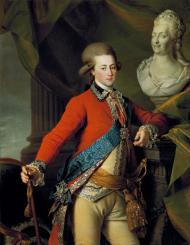
Alexander Dmitrievich Lanskoy, also called Sashin'ka or Sasha, (19 March [O.S. 8 March] 1758 – 6 July [O.S. 25 June] 1784) was a Russian general, favourite and lover of Catherine the Great between 1780 and 1784. It has been said that "[a] look at [her] correspondence with her favorites gives the impression she only had tender feelings for one, Alexander Lanskoi."
Lesen Sie mehr...Catherine II of Russia
Sergei Saltykov

Sergei Wassiljewitsch Saltykow (russisch Сергей Васильевич Салтыков, wiss. Transliteration Sergej Vasil'evič Saltykov; * 1726; † 1765) war ein russischer Diplomat und Adliger aus dem Hause Saltykow. Er ist vor allem bekannt als einer der Liebhaber der späteren Zarin Katharina II. von Russland und möglicherweise der Vater von Zar Paul I.
Lesen Sie mehr...Catherine II of Russia
Pyotr Zavadovsky

Pjotr Wassiljewitsch Sawadowski (russisch Пётр Васильевич Завадовский; * 10. Januarjul. / 21. Januar 1739greg. in Krasnowitschi, Ujesd Starodub, Russisches Kaiserreich; † 10. Januarjul. / 22. Januar 1812greg. in St. Petersburg, ebenda) war ein kaiserlich-russischer Offizier und Staatsmann ukrainischer Abstammung.
Lesen Sie mehr...Catherine II of Russia
Semyon Zorich

Count Semyon Zorich (1743–1799) was a Serbian-born Russian lieutenant-general and count of the Holy Roman Empire. He served Russia against the Prussians and Turks. A member of the Russian court, he was presented to Empress Catherine the Great by Grigory Potemkin and, after having been tested by Praskovja Bruce and doctor Rogerson, became the Empress' lover. He was most influential in the commercial development of Shklov and Mogilev.
Lesen Sie mehr...Catherine II of Russia
Alexander Vasilchikov

Alexander Semjonowitsch Wassiltschikow (russisch: Васильчиков, Александр Семёнович; * 1746 in Moskau; † 1813 ebenda) war ein russischer Aristokrat, Generaladjutant ihrer Majestät Katharina II. und ihr Liebhaber.
Lesen Sie mehr...Catherine II of Russia
Platon Zubov

Prince Platon Alexandrovich Zubov (Russian: Платон Александрович Зубов; November 26 [O.S. November 15] 1767 – April 19 [O.S. April 7] 1822) was the last of Catherine the Great's favourites and the most powerful man in the Russian Empire during the last years of her reign.
Lesen Sie mehr...Catherine II of Russia
Gregory Potyomkin

Prince Grigory Aleksandrovich Potemkin-Tauricheski (11 October [O.S. 30 September] 1739 – 16 October [O.S. 5 October] 1791) was a Russian military leader, statesman, nobleman, and favourite of Catherine the Great. He died during negotiations over the Treaty of Iași, which ended a war with the Ottoman Empire that he had overseen.
Potemkin was born into a family of middle-income landowners of Russian nobility. He first attracted Catherine's favor for helping in her 1762 coup, then distinguished himself as a military commander in the Russo-Turkish War (1768–1774). He became Catherine's lover, favorite and possibly her consort. After their passion cooled, he remained her lifelong friend and favored statesman. Catherine obtained for him the title of Prince of the Holy Roman Empire and gave him the title of Prince of the Russian Empire among many others: he was both a Grand Admiral and the head of all of Russia's land and irregular forces. Potemkin's achievements include the peaceful annexation of the Crimea (1783) and the successful second Russo-Turkish War (1787–1792), during which the armed forces under his command besieged Ochakov.
In 1775, Potemkin became the governor-general of Russia's new southern provinces. An absolute ruler, he worked to colonize the wild steppes, controversially dealing firmly with the Cossacks who lived there. He founded the towns of Kherson, Nikolayev, Sevastopol, and Yekaterinoslav. Ports in the region became bases for his new Black Sea Fleet.
His rule in the south is associated with the (probably mythical) "Potemkin village", a ruse involving the construction of painted façades to mimic real villages, full of happy, well-fed people, for visiting officials to see. Potemkin was known for his love of women, gambling and material wealth. He oversaw the construction of many historically significant buildings, including the Tauride Palace in Saint Petersburg.
Lesen Sie mehr...Catherine II of Russia
Grigori Grigorjewitsch Orlow

Grigori Grigorjewitsch Orlow (russisch Григорий Григорьевич Орлов, wiss. Transliteration Grigorij Grigor'evič Orlov; * 17. Oktober 1734; † 24. April 1783 in Moskau) war Geliebter Katharinas II. und Offizier der russischen Armee.
Lesen Sie mehr...Catherine II of Russia
Stanislaus II. August Poniatowski

Stanisław II. August (eigentlich Stanisław Antoni Poniatowski; * 17. Januar 1732 in Wołczyn, Polen-Litauen; † 12. Februar 1798 in Sankt Petersburg, Russisches Kaiserreich) stammte aus dem Adelsgeschlecht der Poniatowski. Er wurde 1764 mit Unterstützung der russischen Kaiserin Katharina der Großen zum König von Polen und Großfürsten von Litauen gewählt und regierte bis zu seiner Abdankung im Jahre 1795 als letzter der polnischen Wahlkönige. Als Auftraggeber und starker Verfechter der Verfassung vom 3. Mai 1791 (erste moderne Verfassung Europas) gilt er heute als bedeutender Aufklärer.
Lesen Sie mehr...