Wer datete Pedro I of Brazil?
Maria Benedita de Castro Canto e Melo war mit Pedro I of Brazil von ? bis ?. zusammen. Der Altersunterschied betrug 5 Jahre, 9 Monate und 24 Tage.
Florisbela Umbelina Rodrigues Horta war mit Pedro I of Brazil von ? bis ?. zusammen.
Henriette Josephine Clémence Saisset war mit Pedro I of Brazil von ? bis ?. zusammen.
Domitília de Castro Canto e Melo war mit Pedro I of Brazil von ? bis ?. zusammen. Der Altersunterschied betrug 0 Jahre, 9 Monate und 15 Tage.
Pedro I of Brazil
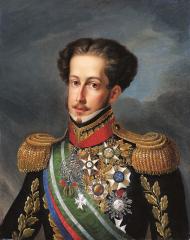
Dom Pedro I (12 October 1798 – 24 September 1834), known in Brazil and in Portugal as "the Liberator" (Portuguese: o Libertador) or "the Soldier King" (o Rei Soldado) in Portugal, was the founder and first ruler of the Empire of Brazil from 1822 to 1831 (under the name of Pedro I) and King of Portugal in 1826 (under the name of Pedro IV).
Born in Lisbon, Pedro was the fourth child of King Dom John VI of Portugal and Queen Carlota Joaquina, and thus a member of the House of Braganza. When the country was invaded by French troops in 1807, he and his family fled to Portugal's largest and wealthiest colony, Brazil. The outbreak of the Liberal Revolution of 1820 in Lisbon compelled Pedro I's father to return to Portugal in April 1821, leaving him to rule Brazil as regent. He had to deal with challenges from revolutionaries and insubordination by Portuguese troops, all of which he subdued. The Portuguese government's threat to revoke the political autonomy that Brazil had enjoyed since 1808 was met with widespread discontent in Brazil. Pedro I chose the Brazilian side and declared Brazil's independence from Portugal on 7 September 1822. On 12 October, he was acclaimed Emperor and by March 1824 had defeated all armies loyal to Portugal. A few months later, Pedro I crushed the short-lived Confederation of the Equator, a failed secession attempt by provincial rebels in Brazil's northeast.
A secessionist rebellion in the southern province of Cisplatina in early 1825, and the subsequent attempt by the United Provinces of the Río de la Plata to annex it, led the Empire into the Cisplatine War. In March 1826, Pedro I briefly became king of Portugal before abdicating in favor of his eldest daughter, Dona Maria II. The situation worsened in 1828 when the war in the south resulted in Brazil's loss of Cisplatina. During the same year in Lisbon, Maria II's throne was usurped by Prince Dom Miguel, Pedro I's younger brother. The Emperor's concurrent and scandalous sexual affair with Domitila de Castro tarnished his reputation. Other difficulties arose in the Brazilian parliament, where a struggle over whether the government would be chosen by the monarch or by the legislature dominated political debates from 1826 to 1831. Unable to deal with problems in both Brazil and Portugal simultaneously, on 7 April 1831 Pedro I abdicated in favor of his son Dom Pedro II, and sailed for Europe.
Pedro I invaded Portugal at the head of an army in July 1832. Faced at first with what seemed a national civil war, he soon became involved in a wider conflict that enveloped the Iberian Peninsula in a struggle between proponents of liberalism and those seeking a return to absolutism. Pedro I died of tuberculosis in September 1834, just a few months after he and the liberals had emerged victorious. He was hailed by both contemporaries and posterity as a key figure who helped spread the liberal ideals that allowed Brazil and Portugal to move from absolutist regimes to representative forms of government.
Lesen Sie mehr...Maria Benedita de Castro Canto e Melo
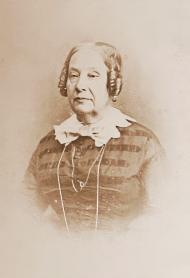
María Benedicta de Castro Canto y Melo (São Paulo, 18 de diciembre de 1792-Río de Janeiro, 5 de marzo de 1857) fue una noble brasileña, baronesa de Sorocaba por matrimonio y amante del emperador de Brasil de quien tuvo un hijo.
Lesen Sie mehr...Pedro I of Brazil
Florisbela Umbelina Rodrigues Horta
Pedro I of Brazil
Henriette Josephine Clémence Saisset
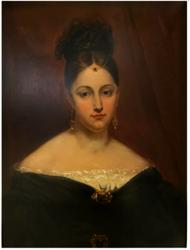
Pedro I of Brazil
Domitília de Castro Canto e Melo
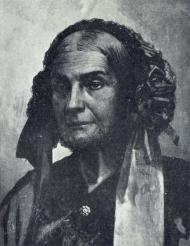
Domitília de Castro Canto e Melo (* 27. Dezember 1797 in São Paulo; † 3. November 1867 ebenda) war eine Geliebte Kaiser Peters I. von Brasilien und ab 1825 Ehrengräfin von Santos, sie wurde 1826 vom Kaiser zur Markgräfin von Santos (portugiesisch Marquesa de Santos) erhoben.
Ihr Vater, Oberst João de Castro Canto e Melo, stammte von den Azoren, ihre Mutter, Escolástica Bonifácia de Oliveira Toledo Ribas, kam aus einer angesehenen Familie São Paulos. Zwei Brüder, João und José, sowie eine Schwester, Maria Benedita, mit der der Kaiser ein illegitimes Kind hatte, bildeten ihre nächste Verwandtschaft.
Mit ihrem ersten Mann Felicio Pinto Coelho de Mendonça, einem Offizier der Dragoner aus Vila Rica, wurde sie sechzehnjährig am 13. Januar 1813 verheiratet. Von ihm ließ sie sich am 21. Mai 1824 scheiden.
Kurz vor der Unabhängigkeitserklärung Brasiliens 1822 lernte Domitília den jungen Pedro de Alcântara kennen, den Thronprinzen des Königreichs Portugal und nachmaligen Kaiser Brasiliens. Obwohl Pedro bis dahin harmonisch seit 1817 mit der Habsburgerin Maria Leopoldine von Österreich verheiratet war, entwickelte sich zwischen ihm und Domitília eine Liaison. Domitília wurde zur Hofdame der Kaiserin ernannt. Die Kaiserin, die immer mehr unter der Affäre ihres Mannes und ihrer Demütigung litt, starb schließlich am 11. Dezember 1826, angeblich als Folge der Misshandlung durch ihren Mann.
Domitília gebar ihrem Geliebten folgende vier Kinder:
- Isabel Maria (* 23. Mai 1824; † 3. November 1898), wurde von Pedro legitimiert und zur Herzogin von Goiás ernannt
- Pedro (* 7. Dezember 1825; † 27. Dezember 1825)
- Maria Isabel (* 13. August 1827; † 25. Oktober 1828)
- Maria Isabel II. (* 28. Februar 1830; † 13. September 1896), Gräfin von Iguaçu
Domitílias Beziehung mit Pedro dauerte so lange an, bis der Kaiser sie 1829 im Hinblick auf seine bevorstehende Hochzeit mit Amélie, Prinzessin von Leuchtenberg, beendete (diese Bedingung war Inhalt einer der Klauseln im Eheschließungsvertrag).
1833 lernte Domitília ihren zweiten Mann kennen, den Brigadier der Armee Rafael Tobias de Aguiar, mit dem sie sich am 14. Juni 1842 vermählte. Dieser Ehe entsprangen sechs Kinder, Rafael Tobias, João Tobias, Gertrudes, Antônio Francisco, Brasilico und Heitor. Gertrudes und Brasilico starben noch im Kindesalter. Nach dem Tode ihres Mannes 1857 zog Domitília von Rio de Janeiro nach São Paulo um, wo sie sich um Arme und Bedürftige kümmerte. Ihr Stadtpalais wurde zu einem kulturellen Zentrum der Gesellschaft São Paulos. Das Gebäude (Solar da Marquesa de Santos) kann heute noch besichtigt werden und befindet sich unmittelbar hinter dem Pateo do Collegio.
Domitília starb 1867 an Enterokolitis und wurde auf dem von ihr gestifteten Friedhof Cemitério da Consolação in São Paulo beigesetzt.
Lesen Sie mehr...