Wer datete Diana von Poitiers?
Henry II of France war mit Diana von Poitiers von ? bis ?. zusammen. Der Altersunterschied betrug 19 Jahre, 6 Monate und 19 Tage.
Diana von Poitiers
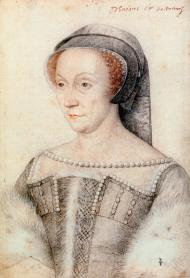
Diana von Poitiers (französisch Diane de Poitiers; * 31. Dezember 1499, 3. September 1499 oder 9. Januar 1500 in Saint-Vallier, Étoile oder Poitiers; † 22. April 1566 im Schloss Anet bei Paris) war Gräfin von Saint-Vallier, seit 1548 Herzogin von Valentinois und seit 1553 Herzogin von Étampes. Bekannt wurde sie als die Mätresse und Vertraute König Heinrichs II. von Frankreich.
Wegen des Altersunterschiedes von rund 19 Jahren zwischen dem jungen Heinrich und seiner älteren Mätresse ist die Beziehung bis heute Ziel von Spekulationen. Obwohl Diana nach dem Tod ihres Mannes Louis de Brézé ein ruhiges Leben als wohlhabende Witwe in der Provinz hätte führen können, kehrte sie aus nicht abschließend geklärten Gründen an den französischen Hof zurück. Sie umsorgte Heinrich, organisierte sein Liebesleben und war unanfechtbarer Mittelpunkt des Hofes. Erst als Heinrich starb, verließ sie den Hof und zog sich auf ihre Güter zurück.
Bis heute gehört sie, aufgrund der ambivalenten historischen und modernen Darstellungen, zu den bekanntesten Frauen am französischen Königshof der Neuzeit.
Lesen Sie mehr...Henry II of France

Henry II (French: Henri II; 31 March 1519 – 10 July 1559) was King of France from 1547 until his death in 1559. The second son of Francis I and Claude, Duchess of Brittany, he became Dauphin of France upon the death of his elder brother Francis in 1536.
As a child, Henry and his elder brother spent over four years in captivity in Spain as hostages in exchange for their father. Henry pursued his father's policies in matters of art, war, and religion. He persevered in the Italian Wars against the Habsburgs and tried to suppress the Reformation, even as the Huguenot numbers were increasing drastically in France during his reign.
Under the April 1559 Peace of Cateau-Cambrésis which ended the Italian Wars, France renounced its claims in Italy, but gained certain other territories, including the Pale of Calais and the Three Bishoprics. These acquisitions strengthened French borders while the abdication of Charles V, Holy Roman Emperor in January 1556 and division of his empire between Spain and Austria provided France with greater flexibility in foreign policy. Nostradamus also served King Henry as physician and astrologer.
In June 1559, Henry was injured in a jousting tournament held to celebrate the treaty, and died ten days later after his surgeon, Ambroise Paré, was unable to cure the wound inflicted by Gabriel de Montgomery, the captain of his Scottish Guard. Though he died early, the succession appeared secure, for he left four young sons – as well as a widow (Catherine de' Medici) to lead a capable regency during their minority. Three of those sons lived long enough to become king; but their youth and sometimes infirmity, and the unpopularity of Catherine's regency, led to challenges to the throne by powerful nobles, and helped to spark the French Wars of Religion between Catholics and Protestants, and an eventual end to the House of Valois as France's ruling dynasty.
Lesen Sie mehr...