Wer datete Charlotte de Beaune-Semblançay, comtesse de Sauve?
Henry IV of France war mit Charlotte de Beaune-Semblançay, comtesse de Sauve von ? bis ?. zusammen. Der Altersunterschied betrug 2 Jahre, 1 Monate und 18 Tage.
Henri I. de Lorraine, duc de Guise war mit Charlotte de Beaune-Semblançay, comtesse de Sauve von ? bis ?. zusammen. Der Altersunterschied betrug 0 Jahre, 9 Monate und 26 Tage.
François-Hercule de Valois, duc d’Alençon war mit Charlotte de Beaune-Semblançay, comtesse de Sauve von ? bis ?. zusammen. Der Altersunterschied betrug 3 Jahre, 4 Monate und 23 Tage.
Charlotte de Beaune-Semblançay, comtesse de Sauve

Charlotte de Beaune-Semblançay, comtesse de Sauve (* 1551; † 1617) war eine Mätresse des französischen Königs Heinrich IV.
Lesen Sie mehr...Henry IV of France

Henry IV (French: Henri IV; 13 December 1553 – 14 May 1610), also known by the epithets Good King Henry (le Bon Roi Henri) or Henry the Great (Henri le Grand), was King of Navarre (as Henry III) from 1572 and King of France from 1589 to 1610. He was the first monarch of France from the House of Bourbon, a cadet branch of the Capetian dynasty. He pragmatically balanced the interests of the Catholic and Protestant parties in France, as well as among the European states. He was assassinated in Paris in 1610 by a Catholic zealot, and was succeeded by his son Louis XIII.
Henry was baptised a Catholic but raised as a Huguenot in the Protestant faith by his mother, Queen Jeanne III of Navarre. He inherited the throne of Navarre in 1572 on his mother's death. As a Huguenot, Henry was involved in the French Wars of Religion, barely escaping assassination in the St. Bartholomew's Day massacre. He later led Protestant forces against the French royal army. Henry inherited the throne of France in 1589 upon the death of Henry III. Henry IV initially kept the Protestant faith (the only French king to do so) and had to fight against the Catholic League, which refused to accept a Protestant monarch. After four years of military stalemate, Henry converted to Catholicism, reportedly saying that "Paris is well worth a Mass". As a pragmatic politician (politique), he promulgated the Edict of Nantes (1598), which guaranteed religious liberties to Protestants, thereby effectively ending the French Wars of Religion.
An active ruler, Henry worked to regularize state finance, promote agriculture, and encourage education. He began the first successful French colonization of the Americas. He promoted trade and industry, and prioritized the construction of roads, bridges, and canals to facilitate communication within France and strengthen the country's cohesion. These efforts stimulated economic growth and improved living standards.
While the Edict of Nantes brought religious peace to France, some hardline Catholics and Huguenots remained dissatisfied, leading to occasional outbreaks of violence and conspiracies. Henry IV also faced resistance from certain noble factions who opposed his centralization policies, leading to political instability. His main foreign policy success was the Peace of Vervins in 1598, which made peace in the long-running conflict with Spain. He formed a strategic alliance with England. He also forged alliances with Protestant states, such as the Dutch Republic and several German states, to counter the Catholic powers. His policies contributed to the stability and prominence of France in European affairs.
Lesen Sie mehr...Charlotte de Beaune-Semblançay, comtesse de Sauve
Henri I. de Lorraine, duc de Guise

Henri de Guise, deutsch Heinrich von Guise (* 31. Dezember 1550 in Joinville (Haute-Marne); † 23. Dezember 1588 auf Schloß Blois), auch Le Balafré (deutsch „das Narbengesicht“) genannt, war der älteste Sohn von François de Guise aus dem Haus Guise, einer jüngeren Linie des Hauses Vaudémont, der seit 1483 regierenden Herzöge von Lothringen, und der Anna d’Este. Er folgte seinem Vater nach dessen Tod vom 24. Februar 1563 bis 23. Dezember 1588 als duc de Guise nach.
Lesen Sie mehr...Charlotte de Beaune-Semblançay, comtesse de Sauve
François-Hercule de Valois, duc d’Alençon
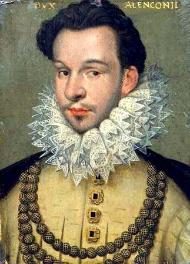
François-Hercule de Valois, duc d’Alençon, deutsch auch Franz Herkules genannt (* 18. März 1555 wohl in Saint-Germain-en-Laye; † 10. Juni 1584 in Château-Thierry), war der jüngste Sohn des Königs Heinrich II. von Frankreich aus dem Haus Valois und dessen Gattin, Katharina von Medici. Alle anderen Söhne des Herrscherpaares wurden nacheinander Könige Frankreichs (Franz II. 1559–1560, Karl IX. 1560–1574, Heinrich III. 1574–1589) oder starben, wie in einem Fall, im Säuglingsalter.
François-Hercule hatte zahlreiche Titel: er war Prinz von Frankreich sowie Herzog von Alençon und Château-Thierry, Graf von Le Perche, Mantes, Meulan (1566–1584), Herzog von Évreux und Graf von Dreux (1569–1584), Graf von Maine, Herzog von Anjou, Touraine und Berry (1576–1584), Graf von Flandern (1582–1583) sowie sieben-facher Pair von Frankreich.
Lesen Sie mehr...