Wer datete Charles II of England?
Margaret de Carteret war mit Charles II of England von ? bis ?. zusammen.
Hortense Mancini war mit Charles II of England von ? bis ?. zusammen. Der Altersunterschied betrug 15 Jahre, 11 Monate und 29 Tage.
Lady Elizabeth Jones war mit Charles II of England von ? bis ?. zusammen.
Catherine Pegge war mit Charles II of England von ? bis ?. zusammen.
Moll Davis war mit Charles II of England von ? bis ?. zusammen.
Frances Stewart, Duchess of Richmond war mit Charles II of England von ? bis ?. zusammen. Der Altersunterschied betrug 17 Jahre, 1 Monate und 10 Tage.
Winifred Wells war mit Charles II of England von ? bis ?. zusammen.
Jane Middleton war mit Charles II of England von ? bis ?. zusammen. Der Altersunterschied betrug 31 Jahre, 6 Monate und 13 Tage.
Nell Gwyn war mit Charles II of England von ? bis ?. zusammen. Der Altersunterschied betrug 19 Jahre, 7 Monate und 25 Tage.
Elizabeth Killigrew, Viscountess Shannon war mit Charles II of England von ? bis ?. zusammen.
Louise de Keroual, Duchess of Portsmouth war mit Charles II of England von ? bis ?. zusammen. Der Altersunterschied betrug 19 Jahre, 2 Monate und 29 Tage.
Lucy Walter war mit Charles II of England von ? bis ?. zusammen.
Barbara Palmer, 1st Duchess of Cleveland war mit Charles II of England von bis . zusammen. Der Altersunterschied betrug 10 Jahre, 5 Monate und 19 Tage.
Charles II of England

Charles II (29 May 1630 – 6 February 1685) was King of Scotland from 1649 until 1651 and King of England, Scotland, and Ireland from the 1660 Restoration of the monarchy until his death in 1685.
Charles II was the eldest surviving child of Charles I of England, Scotland and Ireland and Henrietta Maria of France. After Charles I's execution at Whitehall on 30 January 1649, at the climax of the English Civil War, the Parliament of Scotland proclaimed Charles II king on 5 February 1649. However, England entered the period known as the English Interregnum or the English Commonwealth with a republican government eventually led by Oliver Cromwell. Cromwell defeated Charles II at the Battle of Worcester on 3 September 1651, and Charles fled to mainland Europe. Cromwell became Lord Protector of England, Scotland and Ireland. Charles spent the next nine years in exile in France, the Dutch Republic and the Spanish Netherlands. A political crisis after Cromwell's death in 1658 resulted in the restoration of the monarchy in 1660, and Charles was invited to return to Britain. On 29 May 1660, his 30th birthday, he was received in London to public acclaim.
Charles's English Parliament enacted the Clarendon Code, to shore up the position of the re-established Church of England. Charles acquiesced to these new laws even though he favoured a policy of religious tolerance. The major foreign policy issue of his early reign was the Second Anglo-Dutch War. In 1670, he entered into the Treaty of Dover, an alliance with his cousin, King Louis XIV of France. Louis agreed to aid him in the Third Anglo-Dutch War and pay him a pension, and Charles secretly promised to convert to Catholicism at an unspecified future date. Charles attempted to introduce religious freedom for Catholics and Protestant dissenters with his 1672 Royal Declaration of Indulgence, but the English Parliament forced him to withdraw it. In 1679, Titus Oates's fabrication of a supposed Popish Plot sparked the Exclusion Crisis when it was revealed that Charles's brother and heir presumptive, James, Duke of York, had become a Catholic. The crisis saw the birth of the pro-exclusion Whig and anti-exclusion Tory parties. Charles sided with the Tories and, after the discovery of the Rye House Plot to murder Charles and James in 1683, some Whig leaders were executed or forced into exile. Charles dissolved the English Parliament in 1681 and ruled alone until his death in 1685.
A patron of the arts and sciences, Charles became known for his affability and friendliness, and for allowing his subjects easy access to his person. But he also showed an almost impenetrable reserve, especially concerning his political agendas. His court gained a reputation for moral laxity. Charles's marriage to Catherine of Braganza produced no surviving children, but the king acknowledged at least 12 illegitimate children by various mistresses. He was succeeded by his brother James.
Lesen Sie mehr...Margaret de Carteret
Charles II of England
Hortense Mancini

Hortensia Mancini, auch französisch: Hortense Mancini, (* 6. Juni 1646 in Rom; † 9. November oder 2. Juli oder 16. Juli 1699 in Chelsea) war eine der sogenannten Mazarinetten (französisch: Mazarinettes) und Mätresse des englischen Königs Karl II. Durch ihre Heirat trug sie ab 1661 den Titel einer Herzogin von Mazarin.
Lesen Sie mehr...Charles II of England
Lady Elizabeth Jones

Charles II of England
Catherine Pegge
Catherine Pegge (1635 circa – ...) fu per lunghi anni amante del re d'Inghilterra Carlo II.
Dal sovrano ebbe due figli, Charles FitzCharles, I conte di Plymouth e Catherine FitzCharles.
Figlia di esponenti di classi sociali elevate, seguì la famiglia nell'esilio presso la città belga di Bruges e fu proprio in questa città che iniziò la sua relazione con il sovrano.
Lesen Sie mehr...Charles II of England
Moll Davis
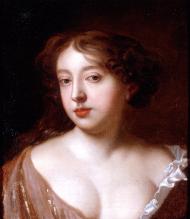
Moll Davis (eigentlich Mary Davis; * 1648 in Westminster; † um 1700 in London) war eine englische Theaterschauspielerin und Kurtisane, sowie die Mätresse von König Karl II. von England.
Lesen Sie mehr...Charles II of England
Frances Stewart, Duchess of Richmond

Frances Teresa Stewart, Duchess of Richmond and Lennox (auch Frances Stuart) (* 8. Juli 1647 in Paris; † 15. Oktober 1702 in Lethington) war eine schottische Adlige und Mätresse von König Karl II. von England. Wegen ihrer Schönheit wurde sie La Belle Stuart genannt.
Lesen Sie mehr...Charles II of England
Winifred Wells
Winifred Wells was a courtier at the Stuart Restoration court as a Maid of Honour to Queen consort Catherine of Braganza. She was also one of the many mistresses of King Charles II of England. Samuel Pepys refers to her as the King's mistress in his diary, and she also features in Philibert de Gramont's famous Mémoirs.
Lesen Sie mehr...Charles II of England
Jane Middleton
Charles II of England
Nell Gwyn

Nell Gwyn (* 2. Februar 1650 oder 1651 wahrscheinlich in Hereford oder London; † 14. November 1687 in London als Eleanour [auch: Ellen Gwyn, Gwynn, Gwin, Gwynne]) war eine Schauspielerin und die im englischen Volk beliebteste der vielen Mätressen des englischen Königs Charles II. Von Samuel Pepys wurde sie wegen ihres Witzes und ihrer spitzen Zunge auch Pretty Witty Nell genannt.
Lesen Sie mehr...Charles II of England
Elizabeth Killigrew, Viscountess Shannon
Elizabeth Boyle, Viscountess Shannon (born Elizabeth Killigrew; baptised 16 May 1622 – December 1680), was an English courtier and mistress of King Charles II.
Lesen Sie mehr...Charles II of England
Louise de Keroual, Duchess of Portsmouth

Louise Renée de Penancoët de Kérouaille, Duchess of Portsmouth (* 1649; † 14. November 1734 in Paris), war eine der Mätressen Karls II. von England und Hofdame Henrietta Anne Stuarts, der Herzogin von Orléans.
Lesen Sie mehr...Charles II of England
Lucy Walter
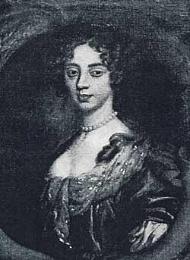
Lucy Walter (* 1630 in Roch Castle, in der Nähe von Haverfordwest, Pembrokeshire, Wales; † 1658 in Paris) war eine walisische Adlige, eine Mätresse des englischen Königs Karl II. und die Mutter von James Scott, 1. Duke of Monmouth.
Durch die Geburt des ersten, offiziell anerkannten, illegitimen Sohnes von Karl II. und die Kinderlosigkeit der englischen Königin Katharina Henrietta, wurden immer wieder Vermutungen und Gerüchte über eine geheime Ehe zwischen Lucy und dem König verbreitet. Lucy wurde von Zeitgenossen wie Samuel Pepys und John Evelyn eher negativ beschrieben. Sie zog keinerlei Nutzen aus ihrer Position als Mätresse und Geliebte von Karl II. und schien sich auch für ihre Umgebung nicht sonderlich viel zu interessieren. Von ihr selbst sind keine Zeugnisse oder Quellen überliefert.
Lesen Sie mehr...Charles II of England
Barbara Palmer, 1st Duchess of Cleveland
Barbara Villiers, 1. Duchess of Cleveland (* November 1640; † 9. Oktober 1709; verheiratete Palmer, Countess of Castlemaine) war neben Nell Gwyn die berühmteste der zahlreichen Mätressen des englischen Königs Karl II.
Lesen Sie mehr...