Wer datete Hephaestion?
Alexander der Große war mit Hephaestion von ? bis ?. zusammen.
Hephaestion
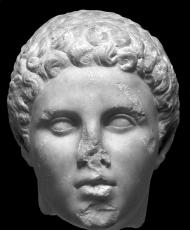
Hephaestion (Ancient Greek: Ἡφαιστίων Hēphaistíōn; c. 356 BC – 324 BC), son of Amyntor, was an ancient Macedonian nobleman of probable "Attic or Ionian extraction" and a general in the army of Alexander the Great. He was "by far the dearest of all the king's friends; he had been brought up with Alexander and shared all his secrets." This relationship lasted throughout their lives, and was compared, by others as well as themselves, to that of Achilles and Patroclus.
His military career was distinguished. A member of Alexander the Great's personal bodyguard, he went on to command the Companion cavalry and was entrusted with many other tasks throughout Alexander's ten-year campaign in Asia, including diplomatic missions, the bridging of major rivers, sieges and the foundation of new settlements. Besides being a soldier, engineer and diplomat, he corresponded with the philosophers Aristotle and Xenocrates and actively supported Alexander in his attempts to integrate the Greeks and Persians. Alexander formally made him his second-in-command when he appointed him Chiliarch of the empire. Alexander also made him part of the royal family when he gave him as his bride Drypetis, sister to his own second wife Stateira, both daughters of Darius III of Persia.
When Hephaestion died suddenly at Ecbatana around age thirty-two, Alexander was overwhelmed with grief. He petitioned the oracle at Siwa to grant Hephaestion divine status and thus Hephaestion was honoured as a Divine Hero. Hephaestion was cremated and his ashes taken to Babylon. At the time of his own death a mere eight months later, Alexander was still planning lasting monuments to Hephaestion's memory.
Lesen Sie mehr...Alexander der Große

Alexander der Große (altgriechisch Ἀλέξανδρος ὁ Μέγας Aléxandros ho Mégas; * 20. Juli 356 v. Chr. in Pella; † 10. Juni 323 v. Chr. in Babylon) war von 336 v. Chr. bis zu seinem Tod als Alexander III. König von Makedonien und Hegemon des Korinthischen Bundes.
Alexander dehnte ab 334 v. Chr. die Grenzen des Reiches, das sein Vater Philipp II. aus dem vormals eher unbedeutenden Kleinstaat Makedonien sowie mehreren griechischen Poleis errichtet hatte, durch den sogenannten Alexanderzug und die Eroberung des Achämenidenreichs bis an den indischen Subkontinent aus. Nach seinem Einmarsch in Ägypten wurde er dort als Pharao begrüßt. Auch aufgrund seiner großen militärischen Erfolge wurde das Leben Alexanders ein beliebtes Motiv in Literatur (siehe Alexanderhistoriker) und Kunst, während Alexanders Beurteilung in der modernen Forschung, wie auch schon in der Antike, zwiespältig ausfällt.
Mit seinem Regierungsantritt begann das Zeitalter des Hellenismus, in dem sich die griechische Kultur über weite Teile der damals bekannten Welt ausbreitete. Die kulturellen Prägungen durch die Hellenisierung überstanden den politischen Zusammenbruch des Alexanderreichs und seiner Nachfolgestaaten und wirkten noch jahrhundertelang in Rom und Byzanz fort.
Lesen Sie mehr...